Work / Report
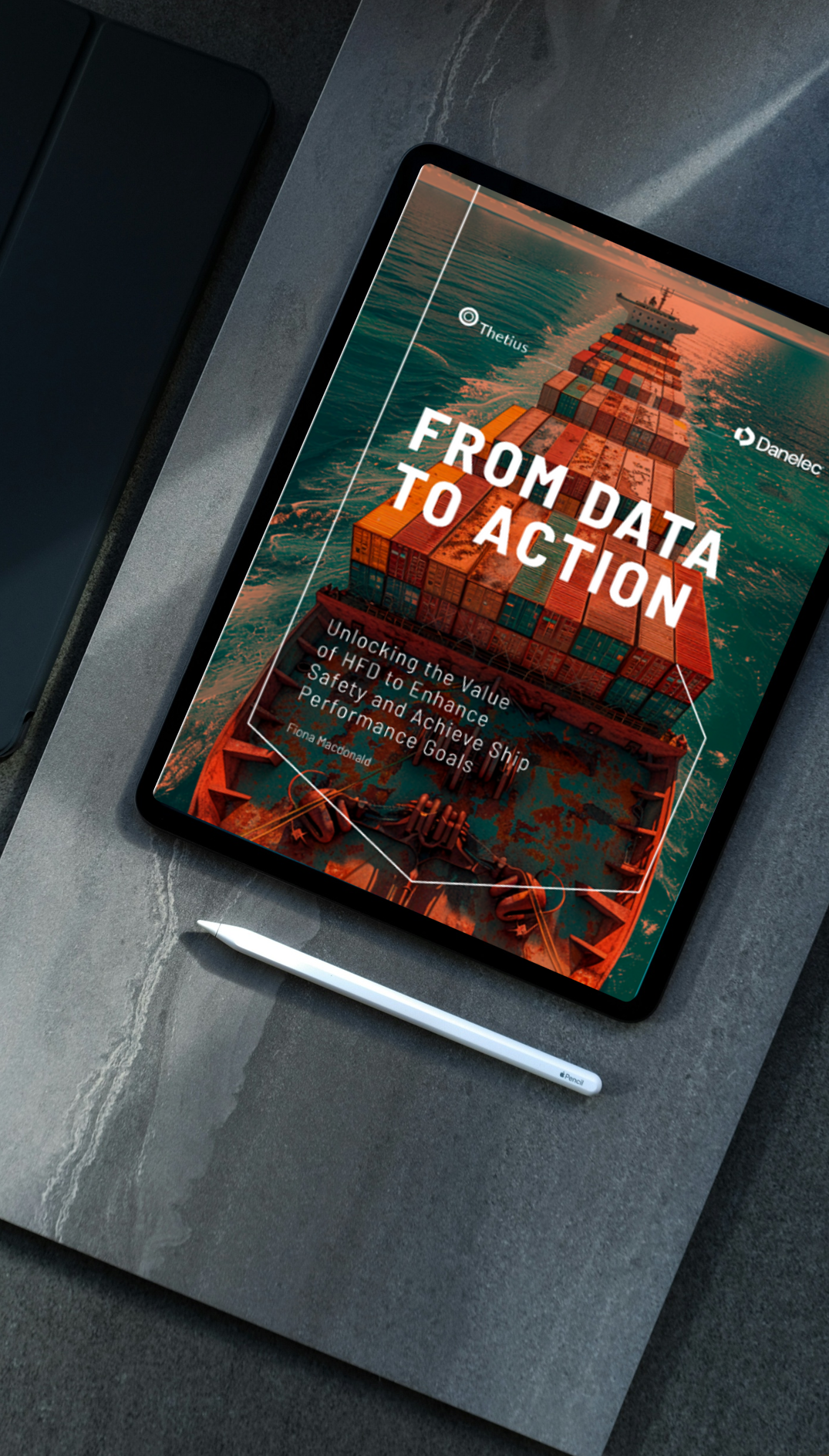
A Thetius report making the case for high-frequency data over once-a-day snapshots, and why the industry's default way of measuring a vessel's performance had quietly become its biggest blind spot.
For decades, the noon report was the industry's unit of truth: a once-daily, manually logged snapshot of fuel consumption, speed, and weather. “From Data to Action”, a Thetius report commissioned by Danelec, took direct aim at that standard, laying out why a single reading a day is no longer enough for an industry under real-time commercial and regulatory pressure.
The report's case was straightforward and hard to argue with: a single daily reading cannot support real-time decisions, cannot catch problems as they happen, and increasingly cannot satisfy regulators asking for defensible, continuous evidence. High-frequency data (HFD), the report argued, is not a nice-to-have upgrade; it is the precondition for shifting maritime operations from reactive to proactive, and for meeting safety and performance goals that noon reports were never built to support.
For Danelec, whose install base of Voyage Data Recorders was quietly one of the largest sources of continuous vessel data in the industry, this was a low-risk, high-leverage move. The report never needed to mention Danelec's own hardware to make Danelec's argument: an industry that agreed high-frequency data was now essential was an industry already primed to see Danelec's fleet-wide sensor footprint as strategic infrastructure rather than a specification sheet.
It was not a product pitch. It was part of a deliberate thought-leadership campaign that gave Danelec's equity story an evidentiary backbone: proof, cited independently and repeatedly in the market, that Danelec was not describing a hardware business with a data add-on, but a company that understood, and was shaping, where the whole category was headed. That case was part of what carried Danelec to its $219M exit.